
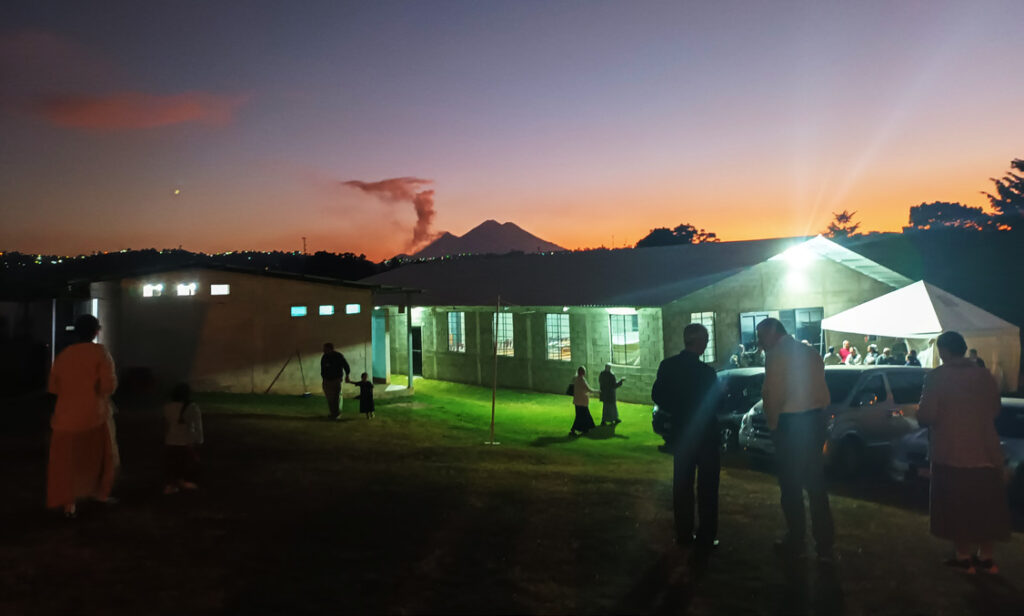
The new chapel proved useful during the pastors’ conference.
2026 Latin American Pastors’ Conference
Ever since we attended the Latin American leaders’ meeting in Honduras in early 2020, this annual event has been a favorite of our family. The conference is hosted in a different Central American country each year, so we have not always been able to attend. However, this year MAM had the privilege and responsibility of hosting the conference here in Guatemala.
As you might imagine, such an event requires much work and preparation on the part of the hosts. The program committee chose topics and speakers months in advance. The food committee created a menu, organized a team of cooks, and bought supplies, including fresh produce at the market in the wee hours of the morning. Various men handled the logistics of picking up people at the airport and bus station and transporting them to “The Farm” or nearby hotels. The nearly finished chapel needed some temporary wiring for the sound system. Bathrooms needed to be cleaned, beds made, the tent set up, and chairs and tables organized. Yes, it was a lot of work, but many willing hands made it all come together.
The event began on Tuesday, February 24, but most people arrived on Monday. Some men came without their spouse or family, but various couples and families attended, resulting in a fairly well-balanced crowd. All told, approximately seventy pastors and their families attended, and we hosted between 220 and 250 individuals at the peak. Folks came from Belize, Canada, Chile, Costa Rica, Ecuador, El Salvador, Honduras, Mexico, Nicaragua, Panama, Peru, and the United States. And we were blessed to have missionaries and pastors from other missions in Guatemala participate as well.
Each day consisted of a couple of messages in the morning, a prayer time in the early afternoon followed by separate sessions for the men and women, and another message after supper. Topics were largely geared toward issues facing those in ministry or mission work. “The Blessing of Serving in the Ministry,” “Balancing Ministry and Family,” “The Role of the Deacon,” and more.
But perhaps just as important as the messages were the times of fellowship with others facing similar struggles, visiting and encouraging one another over mealtimes or praying together in small groups.
There is incredible value in hearing seasoned older brothers share wisdom they have acquired over years of life and service. There is much value in sharing with others in the same type of work, the same stage of family life, or the same sort of isolation.
There is encouragement in simply seeing other parents working to train their children, something that many of us do not see anybody else doing in our “home church!” And it sure is nice to focus on the speaker, knowing that your young children are being cared for and taught by trustworthy sisters during the sessions when childcare is provided! And just getting away from the daily grind and demands of life for a few days can be refreshing. These are the things that make the conference a favorite of ours.
February 26 came quickly, and the shuttle vans began traversing the road between Sumpango and the airport well into the night and throughout the next day. Cleanup, teardown, and returning rented or borrowed items required diligent work, and some committee members did not get home until late Saturday. Yes, three days of near-constant sitting, early mornings, late nights, and the long trip to and from the meetings may indeed be physically and mentally exhausting. But the spiritual refreshment was certainly worth the effort!
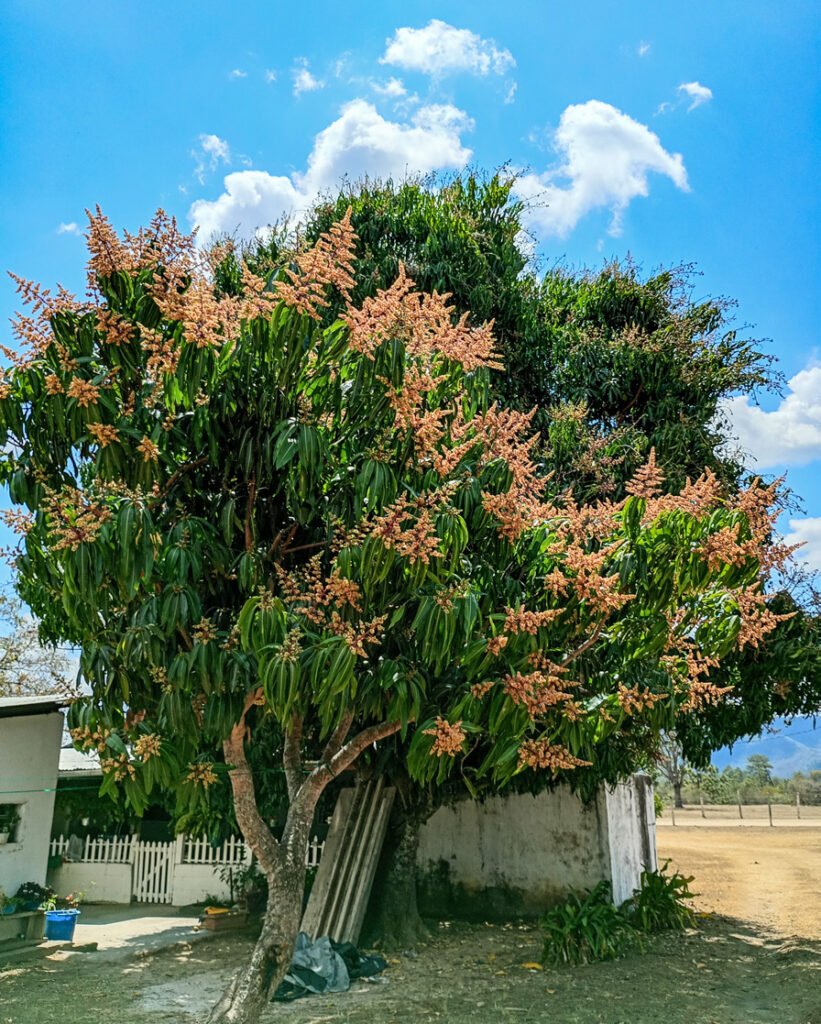
Mango tree in Mixcolajá.
Under the Mango Tree
It is mango time in Guatemala again! The mango tree (Mangifera indica) is one of the most wellknown and beloved fruit trees in the world. Native to South Asia, it has been cultivated for thousands of years and has since spread to tropical and subtropical regions across the globe. The mango tree is primarily valued for its fruit but is also cultivated for its beauty and medicinal use.
Mango trees are large, broadleaf evergreens that can grow up to 100 feet (30 meters) high with a broad, dense canopy. Their deep roots provide stability, allowing them to withstand strong winds and drought conditions. The leaves are glossy, dark green, and elongated, providing dense shade and making the tree a popular choice for home gardens and public spaces. The shade of the mango tree at our church in Mixcolajá generally draws a small crowd and is the place of many conversations!
The mango tree produces small fragrant flowers that develop into fruit, which varies in size, shape, and color depending on the variety. Mangoes have a sweet, juicy flesh surrounding a large pit (seed). The skin of the fruit can range from green to yellow, orange, or even red when ripe.
In our area, many mangoes never get to the yellow, fully ripe stage, because all the neighbors eat the fruit green! They slice up the hard green fruit, and put salt or lemon juice on the slices. They say, “green mangoes have a certain flavor, nearly ripe mangoes have another flavor, but fully ripe mangoes have no flavor at all—because the neighbors already ate them!”
Mango trees thrive in warm, tropical climates with well-drained soil. They require plenty of sunlight and moderate rainfall. While the tree can be propagated through seeds, commercial growers often use grafting to produce high-quality fruits. A mango tree takes about five to eight years to bear fruit, but once mature, it can produce mangoes for decades. A healthy tree produces two crops a year, but in our area, the fruit produced in rainy season is often wormy and inedible.
Mangoes are among the most widely consumed fruits in the world. The fruit is rich in vitamins A and C, fiber, and antioxidants, making it a very nutritious and welcome addition to the Guatemalan diet. Mangoes are eaten in various ways: fresh, juiced, in jams, pickles, and desserts. The fruit’s versatility makes it a staple ingredient in many traditional dishes across different cultures. Other parts of the mango are also useful. The bark produces a yellow dye, and the leaves are used in various folk remedies.
One of the unhandy things about having a large mango tree looming over the back patio and porch is revealed on breezy afternoons. The wind blows and the mangoes fall, sometimes to go “splat” on the ground or “BONG” on the metal roof! Then there is a mess of windfalls to clean up, but that is a great job for little boys! And it is important to clean them up promptly, for the split and splattered fruits quickly attract flies and wasps. Oh, and cows! Cows love to eat mangoes, and perhaps one of the strangest things I have ever seen was one of the neighbor’s (starving) cows rearing up on its hind legs to reach mangoes hanging on the tree (I have several neighbors who can back me up on this!).
During a strange time several years ago, when authorities forbad large gatherings, including church services, several of us met in a mango grove beyond the end of the airstrip on a Sunday morning. This grove had some immense trees next to the meandering creek, and they reminded me of the opening verses of the very first psalm.
“Blessed is the man that walketh not in the counsel of the ungodly, nor standeth in the way of sinners, nor sitteth in the seat of the scornful. But his delight is in the law of the Lord; and in his law doth he meditate day and night. And he shall be like a tree planted by the rivers of water, that bringeth forth his fruit in his season; his leaf also shall not wither; and whatsoever he doeth shall prosper” (Psalm 1:1-3).
What a testimony! May we all live such “evergreen” lives, full of fruits, bringing refreshment to others and giving glory to our Creator!
~ Justin Zimmerman
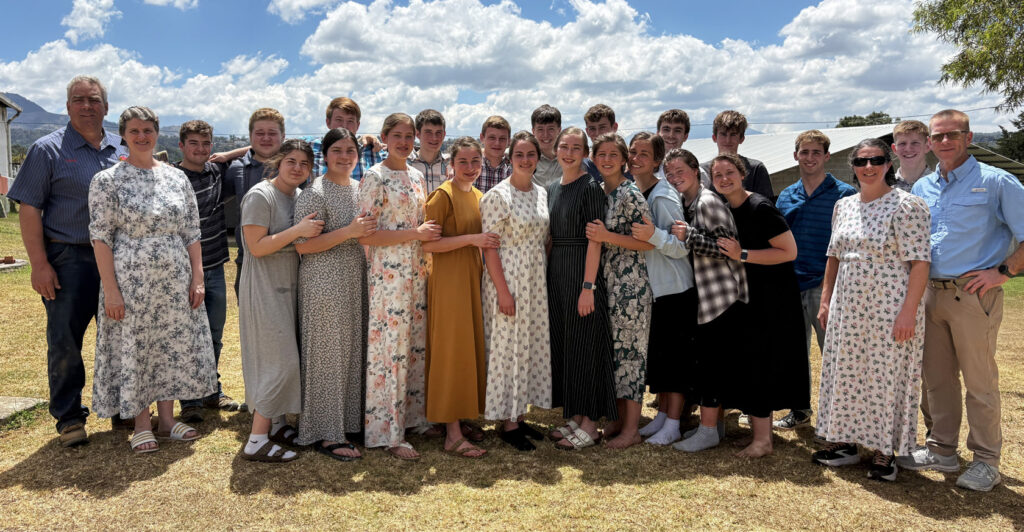
Southeastern Conference seniors from Virginia
Southeastern Senior Trip
In the early morning hours of March 5, the Southeastern Conference seniors from Virginia and their sponsors, Philip and Dana Martin (VA) and Laurel and Tara Eby (WV) arrived at the Finca in Sumpango. MAM mostly uses this property for large events such as institutes and wedding receptions. In the last year a chapel was built on the previously existing concrete pad.
From March 5-9, this group of twenty-one youth painted the inside walls of the new chapel with two coats of primer and one coat of paint. Philip organized the painting project while Laurel and his helpers finished laying blocks on a retaining wall. The ladies oversaw the meal preparation, cooking, and laundry. The girls helped with cooking, laundry, and painting.
On Saturday, the group enjoyed a sightseeing trip to Lake Atitlán. On Sunday they went to Novillero for church. The church group from Joya Grande along with Victor Ovalle and several other visitors were also present. The youth blessed the audience by singing five Spanish songs.
On March 9, they finished the painting, the final concrete pour on the retaining wall, and completed another project down in the ravine where the well is!
The following day after breakfast the senior group left for Guatemala City. After fabric and souvenir shopping, they were dropped off at the airport to return home. Thanks for all the hard work!
~ Delores Graybill
-
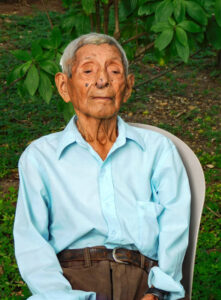
- Francisco (Chico) Segura was the deacon in Oratorio.
-
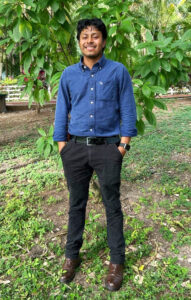
- Jonatán Muñoz died in an accident in February.
Two Funerals in Oratorio
Early Monday morning, February 9, Jonatán Isaías Muñoz Segura died unexpectedly in a car accident. He was 23 years old, the youngest son of Isaías and Domitila Muñoz. Jonatán was not a Christian.
Jonatán’s vela (all-night vigil) was held the night of February 10. Steve Steckley shared the message and the youth sang several songs. Victor Ovalle officiated Jonatán’s burial on February 11.
A week later, on February 16, Brother Francisco Segura Castro died of old age. He was ninety-five years old, the father of Domitila Muñoz and Abraham Segura. “Hermano Chico” as we called him, was a deacon in the Oratorio church and was an encouragement to all. Chico was a hard worker and planted his last field of corn at ninety years old.
Brother Chico’s vela was held the night of February 17. Again, Steve Steckley had the message, followed by the youth singing hymns. He was buried on February 18, with Victor Ovalle officiating.
Pray for the Muñoz and Segura families and the Oratorio church as they grieve. Both men will be greatly missed.
~ Daniel Meyer
Staff News
Farewell to: Lillian Yoder. She returns home after a term of six months at MAM Headquarters. Thank you for your cheerful service!
Prayer and Praise Items
- Pray for the health and safety of the believers and missionaries in Guatemala.
- Praise God for Good News to share in a world full of bad news!
- Praise God for the continued advancement of His kingdom in Latin America.
